
Ask ten horse owners what they bed down on and you’ll get ten different answers, usually delivered with quite a bit of passion.
There genuinely isn’t one “best” bedding for every horse. The right choice depends on how much time your horse spends in the stable, how messy he is, whether you fancy mucking out fully every day or prefer to deep litter, and what you’re happy to pay for and store. Here’s our honest, practical look at the main options so you can work out what suits your set up.
Why Bedding Choice Actually Matters
Bedding isn’t just there to look pretty on a Sunday morning. It cushions joints, soaks up urine, keeps ammonia down, and gives a horse the confidence to lie down and get proper rest. Horses need to lie flat out for REM sleep, and a thin or hard bed will put many off doing it at all. Good bedding also protects hooves from standing in wet for hours on end, which matters hugely for thrush and general hoof health.
So before getting into materials, it’s worth thinking honestly about your own horse and yard.
How Much Time Does Your Horse Actually Spend In?
This changes everything.
- Stabled most of the day (box rest, bad weather, older horses who prefer to potter): you need something absorbent and low dust, because they’ll be breathing it in for hours. Large flake shavings, wood pellets, or miscanthus all do well here.
- In overnight, out by day: you’ve got a bit more flexibility, since the bed only has to cope with one overnight shift. Straw works perfectly well for many horses on this routine.
- Mostly out, only popping in to eat or for grooming: you can often get away with a simpler, cheaper bed and won’t be doing much in the way of daily changes regardless of material.
Straw
Straw is the traditional choice, and there’s a reason it’s stuck around for centuries. It’s warm, it’s usually the cheapest option per bale, and most horses find it comfortable to lie on. Studies have actually shown horses spend more time lying down on straw than on some other beddings, which says something for its comfort.
The downsides are real though. Plain straw isn’t especially absorbent, so droppings and wet patches can be harder to spot and separate out. It’s also relatively dusty, which is a genuine concern for horses prone to coughs or respiratory sensitivity, and the lighter weight means it blows around the yard more easily than heavier materials.
Wheat Straw
The most widely available type in the UK, and the one most horses leave well alone rather than eating, which is handy if you’re worried about a greedy type filling up on bedding instead of hay. It can still carry some dust depending on quality.
Rape Straw
Chopped rape straw has become a firm favourite on many yards. Because the stalk is chopped, it exposes a soft, spongy core that’s noticeably more absorbent than ordinary wheat straw, and it rots down faster too, which your muckheap (and your farmer collecting it) will thank you for. It’s naturally unpalatable to most horses, though a small minority will still have a nibble, so it’s worth keeping an eye on a new arrival. Some owners find it can shift about a little more underfoot than wheat straw if not banked properly.
Miscanthus
Technically a grass rather than a true straw, miscanthus has earned a strong following for good reason. It’s highly absorbent, often quoted as soaking up two to three times its own weight in liquid, completely unpalatable so horses won’t eat it, and very low dust once properly processed. It makes excellent firm banks and tends to stay looking presentable for longer than straw. The trade-off is cost: it sits in the middle to upper price bracket, and can be trickier to find locally compared with straw or shavings.
Wood Shavings
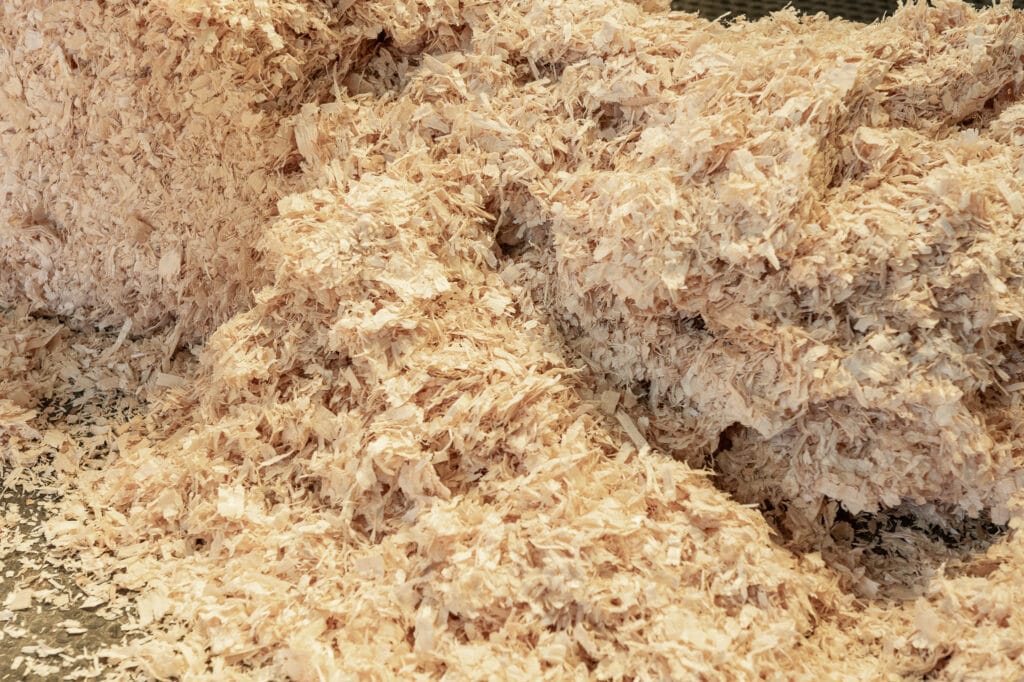
Shavings are probably the most popular bedding in UK yards after straw, and it’s easy to see why. They’re widely available, generally low dust when properly kiln-dried and screened, and easy to muck out since droppings sit on top rather than sinking in.
Large Wood Flakes
Bigger flakes give a softer, fluffier bed with excellent cushioning, which makes them a popular choice for horses who really fling themselves down at night, for foaling boxes, and for anyone needing extra support for older joints. They’re often recommended for horses with respiratory issues too, since the larger particle size generally means less dust. The trade off is that they’re a touch less absorbent than fine shavings, so you may find yourself topping up a little more often in a heavily wet spot.
Sawdust
Sawdust is cheap, easy to come by, and the fine particles make sorting droppings from clean bedding very straightforward. The catch is dust: it’s the dustiest of the wood-based options, which can be uncomfortable for both horse and owner, particularly in a poorly ventilated stable. It’s also bulky to store well in large quantities.
Wood Pellets
Pellets look unremarkable in the bag, but they expand significantly once wet, turning into a soft, sawdust-like material that locks moisture in very effectively. Many owners use a layer of pellets under shavings or straw, specifically under a favourite weeing spot, to boost absorbency without changing the whole bed. Used as a sole bedding they’re extremely economical and quick to muck out, though they offer less natural cushioning underfoot than loose shavings until they’ve expanded properly, so they suit horses who aren’t too fussy about luxury.
Soft Chip
Soft chip sits somewhere between shavings and chopped straw in feel, a slightly chunkier, more textured wood product. Owners tend to either love it or find it underwhelming; it can look fantastic on a clean horse but seems to need topping up generously to avoid looking tired within a day or two on a messier one. It’s a reasonable middle ground if you want something a bit more substantial underfoot than fine shavings without the cost of miscanthus.
Matching Bedding to Your Mucking-Out Style
This is where personal preference comes in just as much as the bedding itself.
Daily Full Muck Out
If you like to lift the whole bed, remove all the wet and droppings, and relay fresh bedding every day, then absorbency matters less because you’re never letting moisture build up. Straw, large flake shavings, and soft chip all work nicely here, since you’re not relying on the material to cope with days of accumulated wet.
Semi Deep Litter
Many owners remove droppings daily but only take out the wettest patches, topping up with fresh bedding on top and doing a fuller strip once a week or so. For this approach, absorbent materials genuinely earn their keep, since they’re managing moisture for longer between full changes. Miscanthus, rape straw, and pellets under shavings all suit this style well.
Full Deep Litter
If you prefer to remove droppings only and let the bed build up over weeks or months before a complete strip out, you need something that can handle sustained moisture without turning sour. Shavings and miscanthus tend to cope better here than plain straw, which can become heavy, smelly, and surprisingly hard work to dig out once compacted. Whatever you choose, it’s worth lifting and checking the base periodically rather than leaving it indefinitely, both for your horse’s respiratory health and for your own back when the day of reckoning finally arrives.
A Few Final Thoughts
There’s no universally “correct” bedding, only the right one for your horse, your routine, and your stable. If your horse has any history of coughing or respiratory sensitivity, prioritise low dust above everything else. If you’re working with a horse who’s particularly wet or messy, lean towards the most absorbent options you can comfortably afford. And if you’re simply not sure, it’s worth trying a few bales of something new before committing, most horses adjust within a few days, and you’ll quickly see which option actually suits your particular four legged friend.
If you’d like a hand working out quantities or delivery for your stable, get in touch, we’re always happy to talk it through.